Get 20% off all printable planners!

Burnout by Notification: How to Regain Focus in an ‘Infinite Workday’
New research reveals interruptions are taking over our time. Here’s a practical system to help you block distractions and finish your day on time.
PERSONAL PRODUCTIVITY & TIME MANAGEMENT
Dennis
6/21/20253 min read


Struggling with constant distractions and never-ending work hours?
You start the day with a plan, but by midafternoon you're knee-deep in emails, chats, and spontaneous meetings. Before you know it, it’s evening. You feel drained, unfinished with critical work, and unable to switch off.
Microsoft’s recent data highlights this modern burnout: knowledge workers receive about 117 emails a day and are interrupted almost every two minutes during working hours (hrkatha.com, ft.com, timesofindia.indiatimes.com). Over half of business meetings are unplanned and people now check work apps as early as 6 a.m. and as late as 10 p.m. .
What is presented as productivity increased connectivity has instead given us perpetual busyness and diminishing returns. You deserve better control over your attention.
A 5‑Step System to Reclaim Your Time and Mind
Here’s a simple but effective framework I’ve built using real habits and experiences:
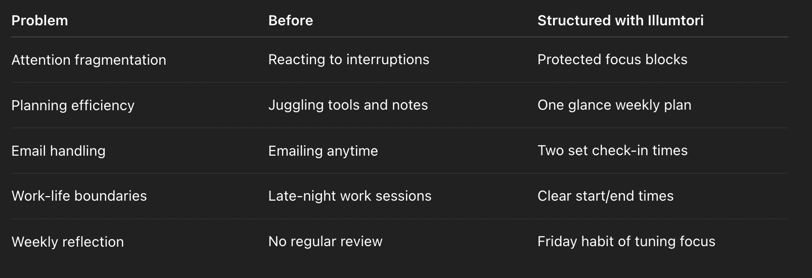
1. Designate Focus Blocks
Choose one or two 90-minute blocks each morning for your most important work. Label them clearly in your calendar to avoid meeting requests and interruptions.
2. Batch Communication
Instead of reacting to every email or message, check and respond only during two scheduled slots (e.g., 11 a.m. and 4 p.m.). This transforms chaos into manageable routine.
3. Mark Clear Boundaries
Define your workday’s start and finish times. Stick to them by turning off notifications and avoiding work after hours.
4. Reflect Weekly on Interruptions
Every Friday, spend five minutes reviewing: How many focus blocks did you complete? Where did interruptions slip in? What will you adjust next week?
5. Protect Focus with Tools and Structure
Use your weekly setup to protect key time slots and make adjustments swiftly.
How Illumtori Supports the System
One tool I personally use to reduce decision fatigue is Illumtori. It helps me visualize my daily priorities in 30 seconds.
In practice:
Sunday evening, I map out two morning focus blocks and communication windows.
Monday morning, I open Illumtori to review tasks and blocks no need to scramble.
Midday, the visual layout reminds me if I’ve stepped into a focus block or drifted.
Friday review, I check the past week and note insights for next week’s layout.
Having this visual structure stops me from reacting to every ping and keeps my attention anchored to what matters most.
Visual Comparison: Before vs With System
Real Example: When Structure Saved Me
Two weeks ago I had three major tasks due: a project pitch, an article draft, and a client update.
Instead of reacting, I scheduled focus sessions for Monday and Tuesday mornings, then set communication batches at specified times. I tracked all of it in Illumtori.
By end of Tuesday, both focus tasks were complete no late nights. By Friday, I saw that interruptions slipped into my Wednesday slot where I hadn’t scheduled protection. That insight helped me guard future blocks with stronger boundaries.
Why This Works (Backed by Research)
Interruptions cost us attention and deep work time: after being pulled away, it takes at least 8–25 minutes to fully recover (arxiv.org, ft.com, hr.berkeley.edu, news.com.au, en.wikipedia.org).
Consistent interruptions increase stress and reduce productivity (workjoy.co).
Designated time blocks and batching communications help protect flow and well-being (ft.com).
Ending the day deliberately restores balance and reduces burnout (completeictnews.com).
Final Thoughts + Soft Call‑to‑Action
You don’t need another fancy time-tracking app. What matters is protecting your time, anchoring your attention, and building simple habits. When you use tools that match the system like Illumtori you reduce friction and keep focus where it belongs: on meaningful work.
If you’re ready to try a more intentional approach:
→ Try Illumtori free today to simplify your daily focus
Shift from fatigue and fragmentation to clarity and effectiveness one protected block at a time.